
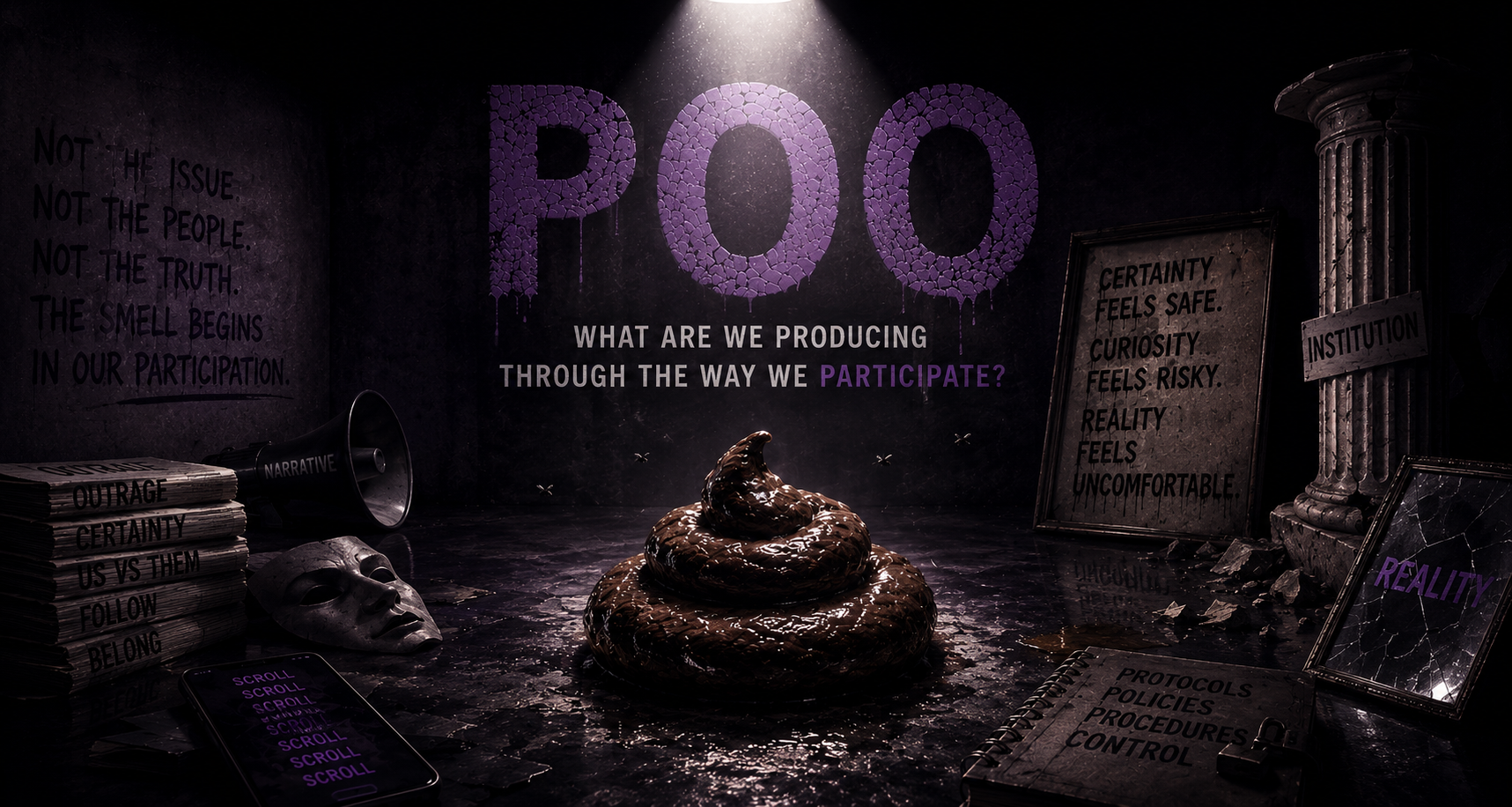
 POO
POO
What Are We Producing Through the Way We Participate?
Some participation creates understanding.
Some participation creates responsibility.
Some participation restores relationship.
And some participation leaves something behind that nobody wants to examine.
A smell.
A residue.
A growing pile of repetition, certainty, performance, outrage, management, division, and avoidance.
That is where POO begins.
Not as an insult.
Not as a judgement.
Not as a declaration that a person, movement, profession, institution, or social issue is worthless.
POO is a catalytic question.
It asks:
What are we participating in that no longer allows reality to interrupt the story?
POO Happens
Human beings participate continuously.
We participate through what we say.
Through what we repeat.
Through what we believe.
Through what we ignore.
Through the systems we maintain.
Through the stories we defend.
Through every click, judgement, diagnosis, vote, policy, silence, and act of belonging.
Participation always produces something.
The question is whether we remain willing to examine what it produces.
Because not everything that looks engaged is alive.
Not everything that looks caring is responsible.
Not everything that looks informed is seeing.
Not everything that looks like progress is participation in reality.
Sometimes participation produces more narrative than understanding.
More certainty than curiosity.
More visibility than responsibility.
More management than meaning.
More noise than reality.
Sometimes participation produces POO.
Why POO?
The word is immediate.
Childish.
Uncomfortable.
Humorous.
Almost impossible to intellectualize.
That is precisely its function.
Many social and institutional conversations have become so abstract, professionalized, ideological, or morally charged that reality can barely enter them anymore.
POO interrupts that seriousness.
It punctures the performance.
It asks a simple question beneath the complexity:
What exactly stinks here?
The answer is rarely the issue itself.
Climate is not the smell.
Politics is not the smell.
Therapy is not the smell.
Sexuality is not the smell.
Mental health is not the smell.
Justice is not the smell.
Identity is not the smell.
The smell begins when our participation in these realities becomes closed, repetitive, self-protective, or no longer corrigible.
The Issue Is Not the POO
A POO Catalyst never declares that its subject is inherently bad.
THERAPY POO does not mean therapy is worthless.
POLITICAL POO does not mean politics is unnecessary.
IDENTITY POO does not mean identity has no value.
CLIMATE CHANGE POO does not deny climate reality.
PRISON POO does not deny the need for safety or accountability.
Every POO Catalyst makes a more demanding distinction.
It asks when something created to serve life begins to protect its own narrative instead.
When does care become management?
When does justice become punishment?
When does belonging become conformity?
When does expertise become certainty?
When does activism become performance?
When does therapy preserve the story it was meant to interrupt?
When does participation stop serving reality?
The Constitutional Pattern
Every POO Catalyst follows a recurring movement.
The subject is not the smell
The catalyst first protects the dignity, necessity, or reality of the subject.
For example:
Therapy is not the smell.
Care is not the smell.
Listening is not the smell.
Healing is not the smell.
The smell begins when…
The catalyst then identifies a possible failure of participation.
When diagnosis becomes identity.
When explanation replaces transformation.
When insight becomes another place to hide.
When the story becomes more important than the person.
The question is not …
The expected debate is interrupted.
The question is not:
Do people need therapy?
The question is …
A deeper inquiry becomes possible.
What kind of therapy remains possible when reality is no longer allowed to interrupt the story?
POO does not close a subject.
It reopens it.
From Social Issue to Participation
Most public debate asks:
Who is right?
Who is wrong?
Who is guilty?
Who should win?
Who should be believed?
Who belongs?
POO asks something else:
What are we strengthening through the way we participate?
What is our outrage producing?
What does our certainty make invisible?
Which reality has been removed from the conversation?
What becomes impossible to see once the story hardens?
Who benefits from continued participation?
What remains when the performance ends?
This shift is essential.
The catalyst is not primarily about the object of debate.
It is about the quality of participation surrounding it.
POO Is Not Neutrality
To question participation is not to avoid responsibility.
It is not an argument that all positions are equal.
It is not a retreat into vagueness.
It is not an excuse to ignore evidence, suffering, power, harm, or accountability.
Reality can require action.
Reality can require protection.
Reality can require boundaries.
Reality can require intervention.
But responsible action must remain corrigible.
Evidence must remain open to further evidence.
Institutions must remain accountable to what they were created to serve.
Movements must remain interruptible by the lives they claim to represent.
Professionals must remain teachable by reality.
POO does not ask us to care less.
It asks us to participate more truthfully.
A Growing Field of Catalysts
The POO series can enter almost any domain in which human participation risks becoming self-reinforcing.
Society and public life
- Climate Change POO
- Immigration POO
- Democracy POO
- Political POO
- Economy POO
- Media POO
- War POO
- Prison POO
Professional and institutional life
- Therapy POO
- Mental Health POO
- Healthcare POO
- Education POO
- Leadership POO
- Compliance POO
- Expertise POO
- Meeting POO
Human and relational life
- Identity POO
- Sexuality POO
- Fear POO
- Talking POO
- Being Unhappy POO
- Belonging POO
- Certainty POO
- Story POO
Each catalyst is visually distinct.
Each returns to the same constitutional inquiry:
What are we participating in that no longer allows reality to interrupt the story?
Visual Catalysts
The visual language of POO is deliberately excessive.
Dark.
Cinematic.
Satirical.
Confrontational.
The images contain recognisable symbols, institutional settings, public slogans, repeated narratives, and an unavoidable central residue.
The POO itself is not the answer.
It is the evidence that something has been produced.
The visual asks the viewer to stop before defending a position.
To notice.
To smell.
To question.
To become curious about their own participation.
The image attracts attention.
The question returns attention to reality.
Textual Catalysts
Every visual can be accompanied by a textual catalyst.
The text does not explain the image.
It deepens the interruption.
It distinguishes the reality of the subject from the reduction surrounding it.
It refuses easy accusation.
It refuses easy innocence.
It does not ask:
Who created this mess?
It asks:
How are we participating in its continuation?
A textual catalyst may be used as:
- a social post;
- a reflection for professionals;
- an opening to a keynote;
- a dialogue prompt;
- a conference intervention;
- a leadership inquiry;
- an institutional mirror;
- a starting point for facilitated conversation.
POO Applies to Reduction & Reality Too
No movement is exempt.
No framework is exempt.
No institution is exempt.
No professional is exempt.
No catalyst is exempt.
Reduction & Reality itself must remain interruptible.
If POO becomes a formula…
If confrontation becomes performance…
If questions become branding…
If the series begins protecting its own certainty…
Then POO has happened here too.
Reality must always remain the deepest authority.
POO as Public Inquiry
POO can be humorous.
But it is not superficial.
It brings a bodily directness into conversations that have become trapped in abstraction.
It reminds us that participation has consequences.
It leaves traces.
It creates conditions.
It strengthens systems.
It shapes perception.
It affects human lives.
We do not only participate in society.
Through participation, we continually produce it.
The challenge is not to eliminate the mess.
The challenge is to become responsible for what we are producing.
Speaking and Dialogue
Every POO Catalyst can become the starting point for a keynote, professional dialogue, institutional inquiry, conference contribution, leadership session, or public conversation.
These sessions do not begin by defending a position.
They begin by examining participation.
Possible themes include:
- When narratives become more authoritative than reality
- How institutions begin protecting themselves instead of serving life
- Why belonging can narrow perception
- The relationship between fear, certainty, and professional responsibility
- When care becomes control
- When explanation replaces participation
- How movements remain corrigible
- What reality asks of leadership
- The difference between visible engagement and responsible participation
These are not motivational presentations.
They are catalytic encounters.
They invite participants to recognise what their systems, stories, habits, and professional certainties are producing.
An Invitation
A POO Catalyst may make you laugh.
It may irritate you.
It may offend your certainty.
It may expose a contradiction.
It may make you want to defend the subject.
Before doing so, pause.
The catalyst may not be asking whether the subject is good or bad.
It may be asking something much closer.
Something more difficult.
Something that includes you.
What are you participating in?
What is that participation producing?
And does reality still have permission to interrupt it?
POO HAPPENS.
What happens next is participation.
QUESTIONS THAT RETURN US TO REALITY
R&R — REDUCTION & REALITY