Opening Question
What if knowledge is not something we store, but something that continues to live, evolve and participate in reality?
Most knowledge systems are designed to organise information.
The ATLAS was developed to cultivate understanding.
Rather than collecting isolated facts, it explores the relationships through which meaning continually emerges.
Knowledge is not treated as static content.
It is approached as a living field of participation.
Orientation
The ATLAS is the living knowledge architecture behind the ongoing research into Reality, Reduction and Participation.
Rather than organising knowledge into fixed categories, The ATLAS develops concepts as interconnected Living Nodes.
Each node remains open.
Each node continues to evolve.
Each node participates in a wider landscape of relationships.
The purpose is not to construct a definitive model of reality.
It is to remain available to a reality that continuously unfolds beyond every model we create.
Field Observation
Traditional knowledge systems often seek stability.
Definitions become fixed.
Disciplines become separated.
Concepts become isolated.
Over time, knowledge risks becoming organised while understanding gradually loses its vitality.
The consequence is subtle.
Information continues to accumulate.
Yet the relationships through which meaning emerges slowly disappear from view.
The ATLAS was developed as an alternative.
Not by rejecting knowledge.
But by allowing knowledge itself to remain alive.
Core Principles
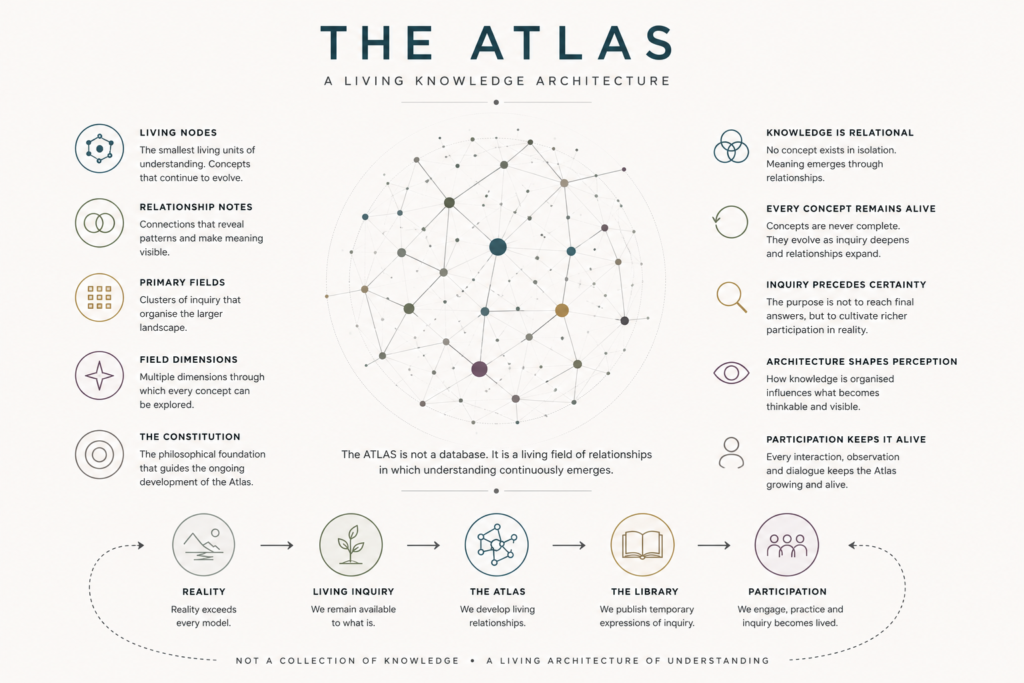
Knowledge is relational
No concept exists in isolation.
Meaning emerges through relationships.
Reality is understood not by collecting disconnected facts, but by exploring the patterns that connect them.
Every concept remains alive
Within The ATLAS, concepts are never considered complete.
Each Living Node continues to evolve as inquiry deepens.
Definitions remain provisional.
Relationships continue to expand.
Understanding remains open.
Inquiry precedes certainty
The purpose of The ATLAS is not to produce final answers.
Its purpose is to cultivate increasingly richer participation in reality.
Every insight becomes the beginning of further inquiry.
Architecture shapes perception
How knowledge is organised influences what becomes thinkable.
A fragmented architecture fragments understanding.
A relational architecture reveals new possibilities.
The structure of knowledge is therefore never neutral.
It actively participates in the realities we become capable of perceiving.
Living Architecture
The ATLAS develops through several interconnected layers.
Living Nodes
The smallest living units of understanding.
Concepts that continuously evolve through observation and relationship.
↓
Relationship Notes
Connections through which patterns become visible.
↓
Primary Fields
Clusters of inquiry that organise the larger landscape.
↓
Field Dimensions
Multiple dimensions through which every concept can be explored.
↓
The Constitution
The philosophical foundation that guides the ongoing development of the entire architecture.
Living Nodes
Each Living Node follows a common rhythm.
Rather than presenting static information, every node invites continued participation.
Its structure includes:
- Opening Question
- Orientation
- Field Observation
- Core Principles
- Living Distinctions
- Field Dimensions
- Relationship Notes
- Bridge
- Current Invitation
The purpose is not simply to communicate knowledge.
It is to keep inquiry alive.
An Evolving Landscape
The ATLAS continues to expand.
Current areas of inquiry include:
- Reality
- Reduction
- Participation
- Truth
- Meandering
- Identity
- Power
- Consent
- Institutions
- Professional Responsibility
- Language
- Culture
- Ethics
- Narrative
- Perception
Each concept develops not as an isolated definition, but as part of a continually evolving landscape of relationships.
Bridge
The ATLAS forms the conceptual heart of this work.
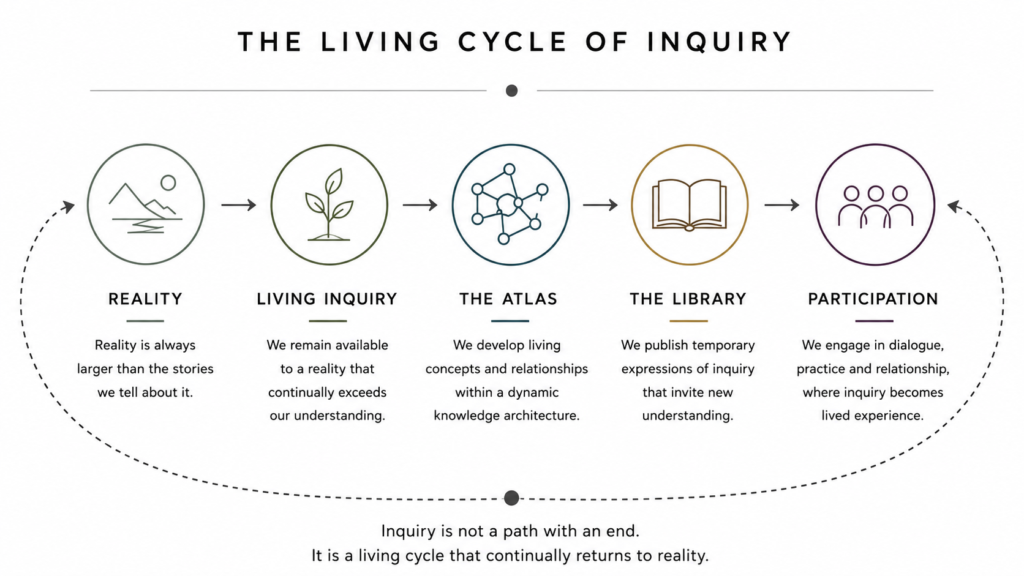
Its foundations are introduced through Living Inquiry.
Its public research appears in Reduction & Reality.
Its publications emerge through The Library.
Its practical expression unfolds through Participation.
Together they form a living ecosystem of inquiry rather than a collection of separate projects.
Current Invitation
As you continue exploring this website, notice how often you encounter concepts presented as finished objects.
Then consider another possibility.
What if every concept remains unfinished?
What if every definition is only one moment within a much larger movement of understanding?
The ATLAS invites you to participate in knowledge as something living.
Not something to possess.
But something to continually inhabit.
Continue
→ Living Inquiry
Discover the philosophical foundation.
→ Reduction & Reality
Explore the ongoing public research.
→ The Library
Read books, essays and monographs.
→ Participation
Join conversations and gatherings.
Closing Reflection
Knowledge becomes living when relationships continue to unfold.