
Opening Question
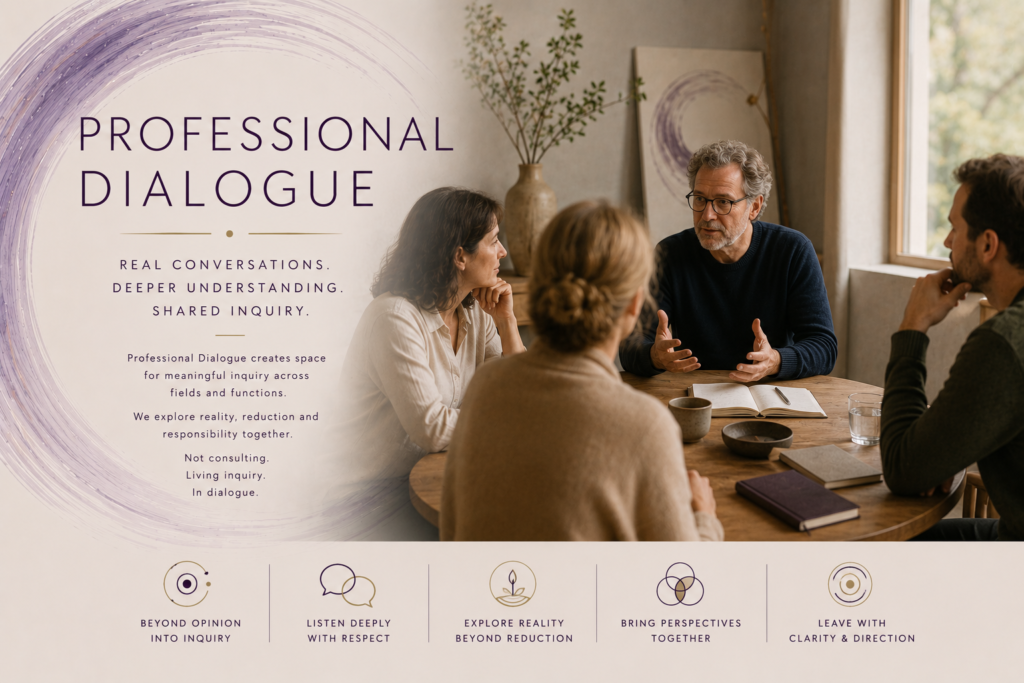
What becomes possible when professionals explore reality together rather than defending established certainty?
Professional life increasingly demands clarity.
Decisions must be justified.
Procedures must be followed.
Responsibilities must be documented.
These expectations are both understandable and necessary.
Yet the realities professionals encounter are often richer, more relational and more complex than the frameworks available to describe them.
Professional Dialogue begins precisely there.
Not by rejecting professional knowledge.
But by creating space where perception can continue to develop beyond established conclusions.
Orientation
Professional Dialogue offers a place where complex realities can be explored without the immediate pressure to resolve them.
Rather than providing predefined answers, these conversations invite participants to examine the assumptions, narratives and reductions that quietly shape professional perception.
The purpose is not agreement.
Nor is it debate.
The purpose is to deepen our capacity to remain present with realities that resist simplification.
Every dialogue becomes part of a wider Living Inquiry into Reality, Reduction and Participation.
Field Observation
Professionals rarely work with simple realities.
Judges encounter competing narratives.
Physicians balance evidence with lived experience.
Teachers navigate individuality within institutional structures.
Leaders make decisions under uncertainty.
Researchers continually revise what they thought they understood.
Yet professional environments often reward confidence more readily than curiosity.
Over time, expertise can gradually become loyalty to familiar interpretations.
Professional Dialogue creates a different kind of space.
A space where inquiry remains possible after expertise has spoken.
Core Principles
Dialogue precedes certainty
Meaning often emerges through conversation rather than prior to it.
Dialogue allows realities to appear that no individual perspective could reveal alone.
Complexity deserves time
Not every meaningful question can be resolved immediately.
Some realities ask to be explored before they can be understood.
Professional Dialogue protects that space.
Expertise remains valuable
Professional Dialogue does not diminish expertise.
It expands the context within which expertise can continue to develop.
Knowledge becomes richer when it remains connected to reality.
Every participant contributes
Dialogue is not the transfer of knowledge from one expert to another.
Every participant enlarges the field through their own experience, perception and professional practice.
Understanding emerges between participants as much as within them.
Areas of Inquiry
Professional Dialogues may explore questions such as:
- Professional Responsibility
- Institutional Complexity
- Reduction & Reality
- Leadership
- Ethics
- Law and Justice
- Healthcare
- Education
- Organisational Culture
- Identity
- Power
- Narrative
- Perception
- Decision Making under Uncertainty
Each dialogue develops in response to the realities present within the participating group.
Bridge
Professional Dialogue forms one expression of the wider Living Inquiry.
Its conceptual foundations emerge through Living Inquiry.
Its research develops within Reduction & Reality.
Its architecture grows through The ATLAS.
Its publications appear in The Library.
The dialogue itself becomes another place where inquiry continues to evolve.
Current Invitation
Consider one professional certainty you rarely question.
Ask yourself:
What realities might become visible if that certainty were held with greater curiosity rather than greater confidence?
Professional Dialogue begins not with disagreement.
It begins with the willingness to continue observing.
Continue
→ Gatherings
Shared spaces for Living Inquiry.
→ Reading Circles
Exploring publications together.
→ Participation Library
Continuing the inquiry beyond individual conversations.