Opening Question
What if the greatest challenge of our time is not the absence of truth, but our diminishing capacity to perceive reality in its fullness?
Every human being reduces reality.
Every profession reduces reality.
Every institution reduces reality.
Every culture reduces reality.
Reduction is not a mistake.
It is the inevitable consequence of being human.
Without reduction, we could not think, communicate or act.
The question is therefore not whether reduction exists.
The question is:
How do our reductions shape the realities we are able—and unable—to perceive?
Orientation
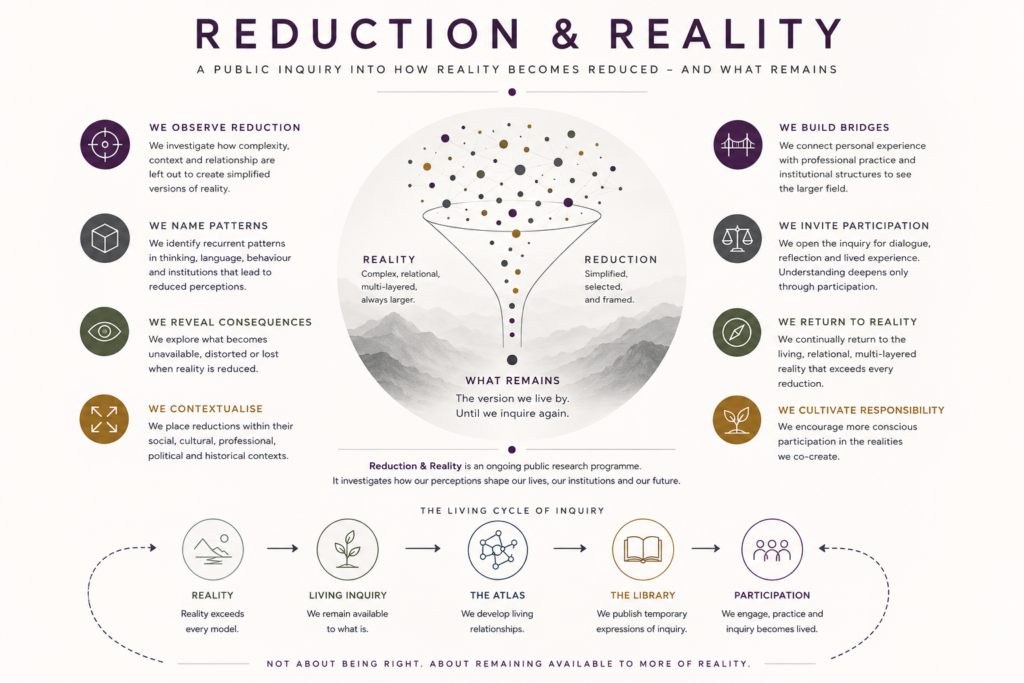
Reduction & Reality is an ongoing field of inquiry into the relationship between human perception and the realities in which we participate.
It explores how individuals, professionals, organisations and societies continuously organise complexity into manageable narratives, concepts, procedures and identities.
These reductions make cooperation possible.
They make science possible.
They make law possible.
They make medicine possible.
They make culture possible.
Yet every reduction also establishes a boundary.
Something becomes visible.
Something else quietly disappears.
Reduction & Reality investigates that disappearing reality.
Not to eliminate reduction.
But to become more conscious participants within it.
Field Observation
Across every domain of contemporary society a familiar pattern emerges.
Institutions become increasingly efficient.
Knowledge becomes increasingly specialised.
Data becomes increasingly abundant.
Processes become increasingly optimised.
And yet many people experience a growing sense that something essential is being lost.
Relationships become compressed into categories.
Human experience becomes translated into measurable variables.
Professional certainty begins to replace lived perception.
Public debate increasingly rewards clarity over complexity.
The consequence is not merely disagreement.
It is the gradual narrowing of the realities we remain capable of perceiving together.
Reduction & Reality asks what happens when the map slowly becomes more influential than the territory it was designed to represent.
Core Principles
Reduction is inevitable
Reduction is not an error to be corrected.
It is the necessary condition of every human perspective.
Every observation selects.
Every concept organises.
Every profession develops specialised ways of seeing.
Without reduction there would be no orientation.
Reality always exceeds reduction
No model can fully contain reality.
No diagnosis exhausts a person.
No legal judgment captures an entire life.
No scientific theory completes the world it describes.
Reality remains fundamentally larger than every attempt to organise it.
Participation shapes perception
We do not merely observe reality.
We participate in it.
Our assumptions influence what we notice.
Our language influences what we describe.
Our institutions influence what becomes socially real.
Perception is always relational.
Responsibility begins with awareness
The purpose of recognising reduction is not to reject expertise or institutions.
It is to practise them with greater humility.
Awareness of reduction expands professional responsibility.
It creates space for dialogue.
It invites continued observation.
Living Distinctions
| Conventional Thinking | Reduction & Reality |
|---|---|
| Searches for objective certainty | Explores situated participation |
| Treats reduction as a problem | Recognises reduction as inevitable |
| Defends established models | Continuously re-examines models |
| Separates observer and observed | Recognises mutual participation |
| Prioritises explanation | Preserves relationship with reality |
| Ends with conclusions | Continues with inquiry |
Research Fields
Reduction & Reality currently develops through several interconnected areas of inquiry.
Professional Reduction
How expertise organises perception.
Institutional Reduction
How procedures gradually replace lived reality.
Cultural Reduction
How collective narratives shape societies.
Narrative Reduction
How stories both reveal and conceal reality.
Linguistic Reduction
How language determines what becomes perceptible.
Ethical Reduction
How responsibility changes once we recognise our own participation.
Participatory Reality
How human beings continuously co-create the realities they inhabit.
Public Research
Reduction & Reality unfolds through multiple forms of public inquiry.
Essays
Exploring contemporary developments through the lens of reduction and participation.
↓
Micro-Phenomena
Small observations revealing larger patterns of human reduction.
↓
Reality Mirrors
Invitations to observe ourselves within everyday situations.
↓
Field Observations
Long-form reflections connecting professional life, institutions and society.
↓
Books and Monographs
More comprehensive explorations emerging from the ongoing research programme.
Bridge
Reduction & Reality does not exist in isolation.
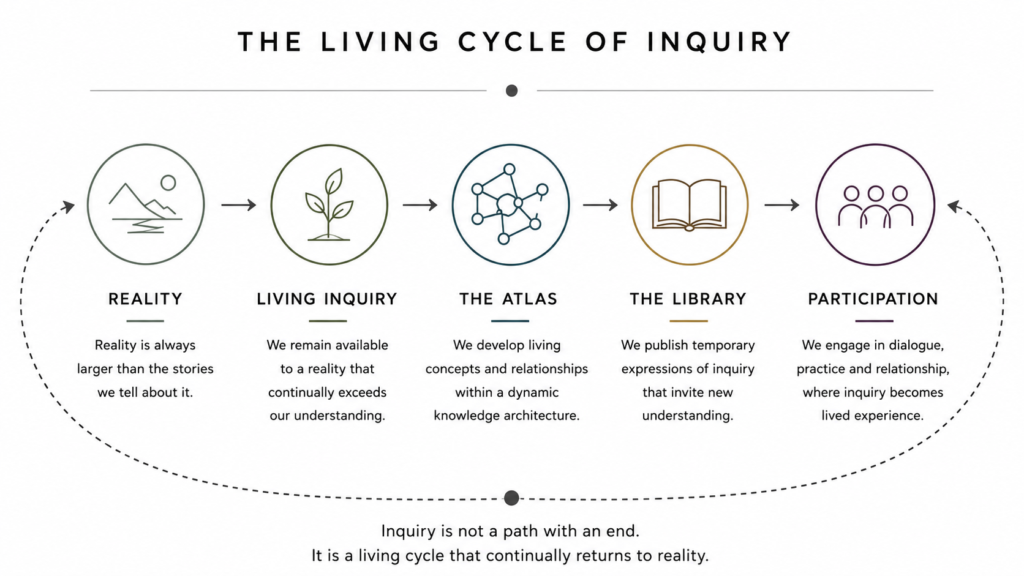
It forms one expression of a broader living inquiry.
Its conceptual foundations continue to develop within The ATLAS.
Its publications are gathered in The Library.
Its conversations become lived experience through Participation.
Together they form an evolving ecosystem of inquiry into reality, reduction and human participation.
Current Invitation
Before leaving this page, consider one situation in which you felt completely certain.
Ask yourself:
What did that certainty allow you to see?
Then ask another question.
What realities may have remained outside that certainty?
Reduction & Reality does not ask us to abandon certainty.
It asks us to remain aware that every certainty illuminates one part of reality while leaving another in shadow.
The work begins there.
Continue
→ The ATLAS
Discover the living architecture behind the research.
→ The Library
Read books, essays and monographs.
→ Participation
Join conversations and gatherings.